

|

|
| There isn’t much between Kaikoura and Christchurch except for a few stretches of seal covered beach. It’s nice, but we had a tough time finding a campsite. Luckily, our handy dandy atlas had a tent icon at Hurunui River Mouth, just south of Cheviot, so we headed to where the river meets the sea.
The lovely bomb shelter-esque bathrooms and deserted camp sites were intimidating at first, but the sign that said “This camp is run on the honesty of campers” and the sunny weather decided it for us. We stayed and it was the best idea ever. Turns out the camping fee was only $4 per site – not per person, like most campsites in NZ – and the creepy bathroom had a mirror, two nice sinks, and full-on flush toilets…simple pleasures these days. There were even a few apple trees with apples still on em, not that we ever want to eat apples again. After night two, we went on a sweet barefoot hike along the river. The mud squishing through our toes was disgusting at first, but then we noticed thousands of bubbles coming from under the water and curiosity had us excitedly digging in the mud to find the source. We never could figure out what was creating the bubbles - maybe oysters or geothermal activity - but in hindsight we’re glad our digging didn’t lead to a geyser exploding in our face. Even though a few other campers came the second night and the mud ended up smelling pretty bad, we’ll remember Hurunui River as our own private getaway. We enjoyed a full moon, cooked some good dinner, and got some much needed quiet time on New Zealand’s beautiful East Coast. Two thumbs up. |
|

|

|

|

|
Showing posts with label budget travel. Show all posts
Showing posts with label budget travel. Show all posts
Sunday, May 30, 2010
Hurunui Campsite

Thursday, May 20, 2010
Blasting Blenheim

|

|
| Care and I were so excited to see some new scenery after what felt like an eternity in the Nelson/Marlborough Region, so we just drove as far as we could before sunset. That got us to Blenheim, a small town in the heart of New Zealand wine country.
We freedom camped just south of town, near a mountain bike track. The parking lot was fine, but it didn’t have any facilities, meaning every morning we had to wake up and speed to town so we didn’t pee our pants. We make every effort to be responsible freedom campers because we want to diffuse the negative stereotypes that locals have about budget travelers. A lot of Kiwis hate freedom campers because there’s always one disrespectful vagabond that litters and poops in the bushes, ruining things for everyone else. There was one small surprise about sleeping among the Blenheim vineyards…hearing constant gunshots. That’s right – constant gunshots. At one point, we thought we were being attacked by canons. It put living in Bed-Stuy, Brooklyn to shame. Apparently there’s a large NZ Air Force base just west of town, and they like to practice…you know in case freaking New Zealand gets invaded. After listening to how much the Royal NZ Air Force practices, I pity any country dumb enough to attack the Kiwis. A highlight of Blenheim was the Sunday morning farmers’ market. A charming old man from a local olive orchard, Tussock, took the time to explain several types of olives they grow, and let us taste the difference in the oils. We were impressed, so we bought a really tasty bottle of garlic-infused olive oil. People keep asking if we think New Zealand is “backwards” or “twenty years behind”, and we’ve always been confused by the question. I mean, things are slower here, but that’s mostly due to the smaller population (4 million), not the lack of any technology or convenience. Sure, free internet is a little tougher to find, central heating doesn’t exist, and don’t even get Carolyn started on how crappy the laundry dryers are here. But other than that, it’s sweet as. Anyhoo… The farmers’ market was one of the only times where saw what people mean about going back in time. The farmers’ markets here are held by…real farmers. It’s not like the pockets of “rural consciousness” that pop up in Union Square or abandoned K-Mart parking lots on a Saturday morning in the States. These people head to the horse grounds in town and sell their produce. Little kids run around getting their faces painted and listening to the “Story Time Lady”. It’s not a pretense at capturing the lost agrarian utopia. It’s just farmers. At a market. Same thing goes for the endless number of fruit stands and “fresh eggs” signs you see on every road and motorway in New Zealand. The simplicity and functionality made me feel transported in time. The only question is, with the frenzied rate that people in the States seem to be going “back” to organic produce and grass-fed animals, is New Zealand a land frozen in the distant past, or a country light years ahead in the future? I know, mind blower, right? You’re welcome. |
|

|

|

|

|
Tuesday, May 18, 2010
Hiking the Abel Tasman National Park

|

|
| Carolyn and I loved the kayaking portion of the Abel Tasman, and while we would have been happy to just hop on a water taxi back to town, we decided to explore the trail back on foot.
We started Day 3 at Onetahuti where we dropped off our kayaks the night before. The hiking trail actually goes further north past Onetahuti (the entire thing is 52 km), but spending six or seven days in the wilderness seemed a little out of our league. We’re a bit lazy if you hadn’t noticed, and generally unprepared, so we skipped the most northern portion of the park and headed south. The trail hugs the same golden sand beaches and granite rock formations we had seen from the kayak, but it was fun to see it all from a different perspective. Right off the bat we plunged into rich forest environs filled with birdsong (thanks again to the Birdsong Trust). I whistled my face off to the fantails that filled the tree branches, and within a few minutes we had a pretty good crowd of birds hopping from tree to tree along with us. They are incredibly social birds, and will dance for anyone that seems interested. They also like to swoop right in front of your face. It's a jolting experience. A lot of the trail is nestled in the trees with frequent scenic lookouts, keeping you fairly cool as you wind your way up and down gradual (and some not so gradual) ascents of the granite cliffs. We took the occasional break for photo-ops and snacks, but for the most part the hike is extremely do-able. I wore hiking boots, but Care did the whole thing in Chacos. A unique feature of this particular Great Walk is the existence of four tidal crossings at Bark Bay, Torrent Bay, Onetahuti Bay, and Awaroa. The tide depth in the park can fluctuate by as much as 5.2 meters, meaning that at high tide, some of the trails are submerged. Low tide and high tide are generally 6 hours apart, so most of the crossings are only passable during a 4-hour window, 2 hours before and after low tide. Get a tidal chart from the Nelson or Motueka i-site and do some planning ahead of time, or else you’ll have to:
As disgruntled as we were about our early start at Torrent Bay on Day 4, the stillness of the morning was pristine. The best part is when the track emerges from the tree line to expose amazing views of the park’s bays and islands. One of the most stunning views is from the peak atop Anchorage Bay, looking north at dawn. New Zealand is called “Aotearoa” in Maori which literally means “land of the long white cloud”, and Care and I have been lucky to see an almost non-stop parade of epic cloudy sunsets. The sun lights row upon row of clouds on fire each evening…probably every morning too but we catch wayyyy fewer of those. It’s always amazing, but the Abel Tasman was exceptional. We bought a tent just for this trip, and in retrospect, I wish we had bought a small cooker (cookers are not provided in the Abel Tasman DOC huts or campsites). Cereal, PB&J sandwiches, and cold pasta held us over for four days, but the first thing we did after the hike was inhale five pizzas at 623 Bar’s all-you-can-eat pizza night. Ignoring a few sandfly issues (don’t forget your DEET!), it’s easy to see why the Abel Tasman National Park is the most visited park in New Zealand. Whether it’s by land or sea, everyone can easily and affordably enjoy the pristine beauty of the natural surroundings. We definitely recommend the kayak/hike combo. It’s a sweet taste of both worlds. |
|
|
There's a sweet photo album here, but it looks like your device doesn't support Flash.
No worries! Simply view the web album on Picasa. |
|
Wednesday, May 5, 2010
Motueka
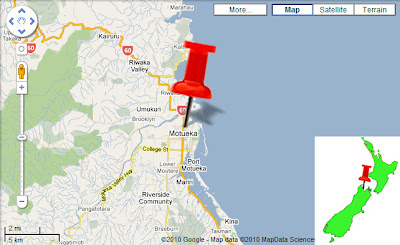 |  |
| Motueka…man this place haunts my dreams. Care and I came to this hamlet in apple picking country with high hopes of landing a job in the fields and getting our hands dirty with a real “Kiwi experience” underneath the summer sun. Little did we know that the worst thing that could happen to us was getting our wish. Our job search started with online applications and endless phone calls to uninterested orchards who were “full for the season” even though Motueka's harvest hadn't even started. We persevered and enlisted the help of the local picking job agency for over a week to no avail. Freedom camping near the ocean fed salt baths on the edge of town lost its appeal, and we wore out our welcome with the librarians/guardians of the only free WiFi in town. After some more time bashing our brians against message boards and job listings we pulled out our secret weapon – charm. Oh that’s right, we got mad charm. We’d visited the same lady - Anne - for over a week in the picking job placement office, and she'd come to recognize us amidst the sea of eager backpackers. We were bright eyed, polite, deferential, and now – desperate. We flattered her and thanked her and did everything to put this lovely middle-aged lady in our pocket. After a few eyelashes were batted and a sighing, “thank you so much for trying” was given, we left her office ready to give up and head south. No more than an hour later our phone rang. Who was it? Anne offering us work with Birdhurst Orchard the following morning. Shazaam - mad charm. Little did we know our Motueka fairytale was about to become a nightmare. But more on that next time… | |
 |  |
Wednesday, April 28, 2010
Nelson

|

|
| Oh Nelson…what can I say about you? Robbery, apple picking, all you can eat pizza deals, freedom camping, the beach, the library – all of these things shaped our time in the principle city of the Nelson Region on the South Island.
Freedom camping is the only way to stay in Nelson for any extended period of time, and Care and I parked at our fair share of locations. The three that were the most effective were (in order of ease):
For long-term campers like us, pricey holiday park accommodation simply isn’t an option. So we did run into some hassles, and we had our car broken into at one point, but that was in the middle of the day and didn’t happen at any of the sites mentioned above. We saved a lot of money by staying in Nelson 16 nights over the course of a month, but we're still a bit undecided on whether it was worth all the effort. Freedom camping really makes you appreciate the simple luxuries of running water, sinks, and toilets inside a house. |
|

|

|
| Aside from all that, Nelson is great. The Information Site is helpful and well staffed, public bathrooms are everywhere, the movie theater has current films, a few bars in the area serve great brews and have WiFi, and there is free (but slow) WiFi at the central library. Care and I were at the library a lot – it’s where this blog was born - and we enjoyed our stay in town.
Drink and food deals exist at different places throughout the week, but our favorite spot was 623 Bar. On Wednesdays they have all you can eat pizza for $15. Done. Care and I actually went there for St. Patrick’s Day and scarfed ourselves into a coma on five different gourmet pizzas, including one deliciously rich banana chocolate dessert pizza. We waddled out of that place exhausted but proud. It’s hard to sum up Nelson into one post, yet it’s not quite worthy of being split up into more. Should we have stayed as long as we did? No. Were parts of it really cool? Sure. Freedom camping, free WiFi, and pizza, pizza, pizza. Not a bad combo, but Care and I were happy to move on. |
|
|
There's a sweet photo album here, but it looks like your device doesn't support Flash.
No worries! Simply view the web album on Picasa. |
|
Monday, April 26, 2010
The Elusive Kiwi and Pelorus Bridge

|

|
|
Our first decision on the South Island was to vote against heading north into the Queen Charlotte Sound, even though it’s highly recommended. The tours are pricey, the roads are unpaved, and while the hiking is supposed to be epic, we’re more stoked to hike/kayak the Abel Tasman National Park – a five day excursion. We don’t want to peak before we get to the Tasman. So we headed west.
On the way to Marahau (the entry point for the Abel Tasman Park), we found a great little DOC campsite called Pelorus Bridge. I’m a big fan of freedom camping, but this Serviced DOC campsite is one that I can highly recommend. The facilities at Serviced sites are a lot nicer than the Basic or Standard DOC sites and traditionally feature gas cookers, flush toilets, ample space for camping, excellent trails through the woods, and a hot shower – so worth ten bucks a night. We planned on hiking down to the river, but as I was shoveling down some cocoa pops, nature came to us. Out of nowhere Carolyn freaked out behind the van. She squealed, “KIWI!! I SEE A BABY KIWI!!! BLAAAARGGGRAAAAAGGGGRRGRH KIWIIIIIIIIIIII!!!!!!!!!!!!!!!!” I dove out of the van to see the elusive bird, confused that it was out during the daytime (they’re nocturnal) and saw instead a little brown bird with huge feet. It resembled a kiwi, but didn’t look quite right. The beak was too short and the talons on its feet were gargatumongahugical. Much to our dismay we found out the bird wasn’t a kiwi – it was another flightless bird, the weka. It didn’t matter though because it was fun to feed the curious family. Pelorus Bridge provided us with a nice hot shower, our first kiwi false alarm, and our first weka sighting. Not too shabby. |
|
|
|||||


|

|
|
"Kiwi Sighting" - a comic by Shawn Forno

|
|
Monday, April 19, 2010
Wellington - Part Five - Freedom Camping
 |  |
| Alright. I’m taking this opportunity in the fifth and final installment of our (S)Wellington Extravaganza! to talk about something near and dear to my heart – Freedom Camping. Freedom Camping is the subtle art of living in a van, camper, hollowed out VW Bug, what have you, allowing travelers to enjoy a country for much longer than they could if forced to pay for conventional accommodation like hostels, campsites, or hotels. The average price of a single bed in a Wellington is $26 – not ridiculous, but the cost for Care and I to stay for 7 days would have quickly mounted to $364 for the week, without including the savage parking fees our van would have incurred (some streets charge $6 per/hr Mon – Fri 8 am – 6 pm). For just five weekdays of parking we might have had to pay $200. Not on my watch. Instead we drove 3 km outside of downtown to a lovely parking lot situated on Oriental Parade – a major street leading to the waterfront/museum district of downtown. When we pulled up we saw a half dozen other freedom campers in their garishly painted campervans all cooking, sitting out in the sun, or going for a quick swim at the adjacent sandy beach. Score. The parking lot is one of several hugging the western side of the bay, and acts as a fishing area during the daytime hours. At night, freedom campers descend on the lot which also provides a bathroom to wash up, clean dishes, and…you know…use the bathroom. Freedom camping in New Zealand is a strange tradition. It’s not illegal which is cool, but it is becoming more and more restricted in certain parts of the country. I get that some communities don’t want travelers squatting their neighborhoods, but the best and most surprising part about Wellington was that they had set aside these areas for travelers. We were never hassled about staying there, we never felt unsafe, and we had access to awesome beach front views, swimming, and amenities just a thirty minute walk into downtown Wellington. It’s funny, the city was hosting a 15 km “Fun Run” that used Oriental Parade as the route, and at 7 a.m. a race official actually came around knocking on windows informing each camper that the road would be closed for the next four hours if we needed to leave before we got trapped. It wasn’t done maliciously or with the intent to roust us from our perch. It was an actual courtesy. Care and I decided to stay and watch the race. Carolyn and I enjoyed one of our best weeks in New Zealand in Wellington, and while it was in large part due to Rich and Merridith, the great museums, cafés, and nightlife of Wellington itself, I’m not sure how much of any of that we would have been able to enjoy if we were paying over $500 to stay for one week. Freedom camping, while controversial and a negative side effect of travel to some, was the thing that really opened up doors for us in Wellington. Without it, we wouldn’t have loved Windy Welly enough to write this five part extravaganza. So, thank you Wellington. Thank you for realizing that just because some travelers don’t have a lot of money it doesn’t mean they can’t enjoy your city. Wellington is Swellington. | |
 |  |
Wednesday, April 7, 2010
Oakura Tide Pools
 |  |
| Freedom camping is a strange thing – once you start, it’s hard to stop. The fun of freedom camping started when Care kept track of the nights we paid to camp and the nights when we found a great spot and just winged it. Over the past few weeks the list showed a growing number of freedom camping nights until the scales finally tipped to make “freedom camping” our accommodation of choice at Oakura Beach. This little stretch of boardwalk and sand 10 km south of New Plymouth isn’t all that much, just a public restroom, showers, and water taps, but waking up thirty feet from the water makes up for a lot. For example, on our second day here grey clouds moved in, snuffing out any hope of a sunny day on the shore. However, for some reason we took a nature walk along the beach to the scattered boulders and shallow tide pools just a half km from our campsite. Next thing we know we’re picking up eleven-armed sea stars (we looked it up and that’s their actual name), pointing out other smaller different starfish (which we didn’t look up, but are pretty cool regardless), getting into staring contests with crabs, touching the sticky tentacles of sea anemones, fording streams, and planting stick trees. Care loved it, and it reminded me of home. What can I say, living for free is addicting. | |
| This photo album requires Flash. If your device does not support Flash, you can view the web album on Picasa.
| |
Monday, March 1, 2010
Flash the Van
What’s the best way to see New Zealand

Pete rigged Flash with two batteries – one for the car and another that charges while we drive. Then he hooked it up to a monster inverter that charges our laptops and chilly bin. It’s awesome.
The best part is that strangers initiate ten minute long conversations about how awesome our van is every time we open up the back to make a sandwich. And we make a lot of sandwiches.


Here’s what he’s packing:


Pete rigged Flash with two batteries – one for the car and another that charges while we drive. Then he hooked it up to a monster inverter that charges our laptops and chilly bin. It’s awesome.
We bought him for $3,000 NZD and spent a few bucks buying lumber, bedding, knick knacks, the chilly bin, etc. and outfitting him the way we liked, but the grand total with registration, Warrant of Fitness, and a handmade super van was $1,500 USD each. Pretty sweet, eh?
It was awesome building the inside ourselves. When we started we just had an empty van, so looking back now, we’re really proud of our work (carpentry is hard). Flash is our home on the road, and he’s taking real good care of us while we explore New Zealand.

It was awesome building the inside ourselves. When we started we just had an empty van, so looking back now, we’re really proud of our work (carpentry is hard). Flash is our home on the road, and he’s taking real good care of us while we explore New Zealand.


The best part is that strangers initiate ten minute long conversations about how awesome our van is every time we open up the back to make a sandwich. And we make a lot of sandwiches.
Click the photo below to see the complete awesomeness of Flash
Subscribe to:
Posts (Atom)

 Posts
Posts


